
Start an Albany Residents Directory Search
Begin with the record keyed to the clue already in hand. A street address points first to Dougherty County qPublic. A person's name can go into the owner roll, the Clerk of Superior Court's RE Search, court indexes, or state license and corporation searches. An older address belongs in Albany city directories, newspapers, census schedules, and Sanborn maps. Postal addresses using “Albany” can extend beyond the city, so confirm the parcel, county, and city limit before choosing a custodian.
No official roll is a full household list. An assessor card identifies an owner, not every occupant. The individualized voter tool needs identifying inputs and is not open browsing. A deed identifies parties to a land transaction, while directories and census records capture dated snapshots. The search works best when two independent facts, such as a middle initial and parcel or a spouse and date, agree.
- Search Dougherty qPublic by owner, location, or parcel and note the situs, mailing address, and parcel ID.
- Use Georgia My Voter Page only when the required identifying facts are already known.
- Check Dougherty RE Search for deeds, liens, plats, and spelling variants.
- Use the Digital Library of Georgia and Central Library for earlier Albany households.
- Send a bounded request to the correct city or county custodian when an index is absent.
Offices Behind the Albany Residents Directory
Albany is Dougherty County's seat, which puts several key custodians close together but does not merge their duties. The Superior Court clerk records deeds and keeps superior and state court files. The Board of Assessors maintains the parcel roll. The joint Board of Registration and Elections administers local voter records. Albany's City Clerk holds municipal minutes, ordinances, campaign disclosures, and permanent city records, while Probate Court separately handles estates, marriage licenses, and local vital copies. For a parcel-by-parcel method, use the Albany street directory.
Clerk of Dougherty Superior Court
225 Pine Ave., Suite 126
Albany, GA 31701
(229) 431-2198
Dougherty Registration and Elections
222 Pine Ave., Suite 220
Albany, GA 31701
(229) 431-3247
Dougherty qPublic Turns an Albany Address into a Parcel
The county property portal is the fastest official bridge from an Albany address to an identified piece of land. Search by owner name, location address, parcel number, or advanced criteria. A parcel card can supply the situs address, owner's mailing address, parcel ID, legal description, transfer history, exemptions, value, building data, and year built. The map opens parcel geometry and nearby assessment parcels. Mailing and situs addresses serve different purposes, and neither proves who occupies the home.
| qPublic search route | Useful input | Resident-directory clue |
|---|---|---|
| Owner | Surname and given-name variants | Assessed ownership and mailing address |
| Location | Street number and street name | Situs parcel and current card |
| Parcel | Recorded parcel identifier | Stable link between map and assessment |
| Advanced | Multiple property criteria | A narrower set for careful comparison |
Four record terms
Roll: an official list maintained for an administrative purpose. Index: a finding aid that points to a document. Parcel: a mapped unit of land. Criss-cross directory: a historical volume arranged by address rather than only by surname.
Albany Deeds Link Names to Recorded Land
The Clerk of Dougherty Superior Court's RE Search offers free data and document images for deeds, liens, and plats. Its name screen accepts at least two letters and supports party, date, book, and instrument filters. The land-description screen can search subdivision, district, land lot, block, lot, and unit. Start with the current qPublic owner as grantee near a transfer date, inspect the deed, then use the grantor and legal description to move backward.
The public landing page does not state the earliest online year. Older work therefore continues at the clerk's counter and in bound books rather than assuming an unsupported cutoff. RE Search itself advises trying spelling variations, a useful rule across Albany sources because historical directories and OCR can also alter names.
The Dougherty real-estate search screen shows how the free index is organized.
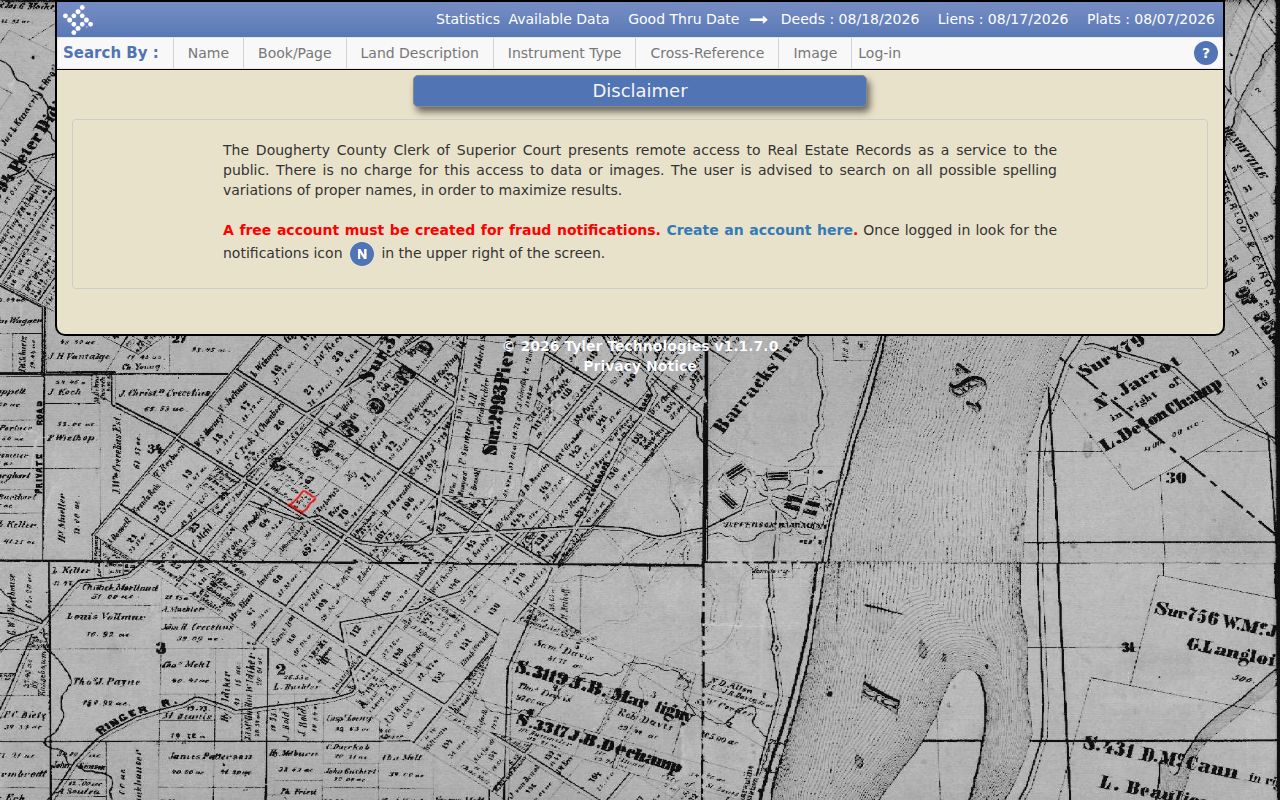
That screen is the handoff point from a current parcel card to the recorded instrument and its document image.
Georgia My Voter Page Is a Check, Not a Street Roll
Georgia's My Voter Page asks for first initial, last name, county, and date of birth. A match can show status, polling place, precinct and district information, elected officials, sample ballots, and absentee information. It does not reveal ballot choices, and Georgia does not register voters by political party. Because the form needs personal facts, it is an individualized verification tool rather than a browseable Albany directory.
Georgia law generally opens voter lists under O.C.G.A. §21-2-225 while protecting Social Security and driver's-license numbers, full birth dates, phone numbers, email addresses, and protected-program data. Separate paid voter-file orders have statutory restrictions. Never use directory sources to reconstruct or publish a protected person's address.
The official Georgia My Voter Page makes the required fields clear before any lookup begins.
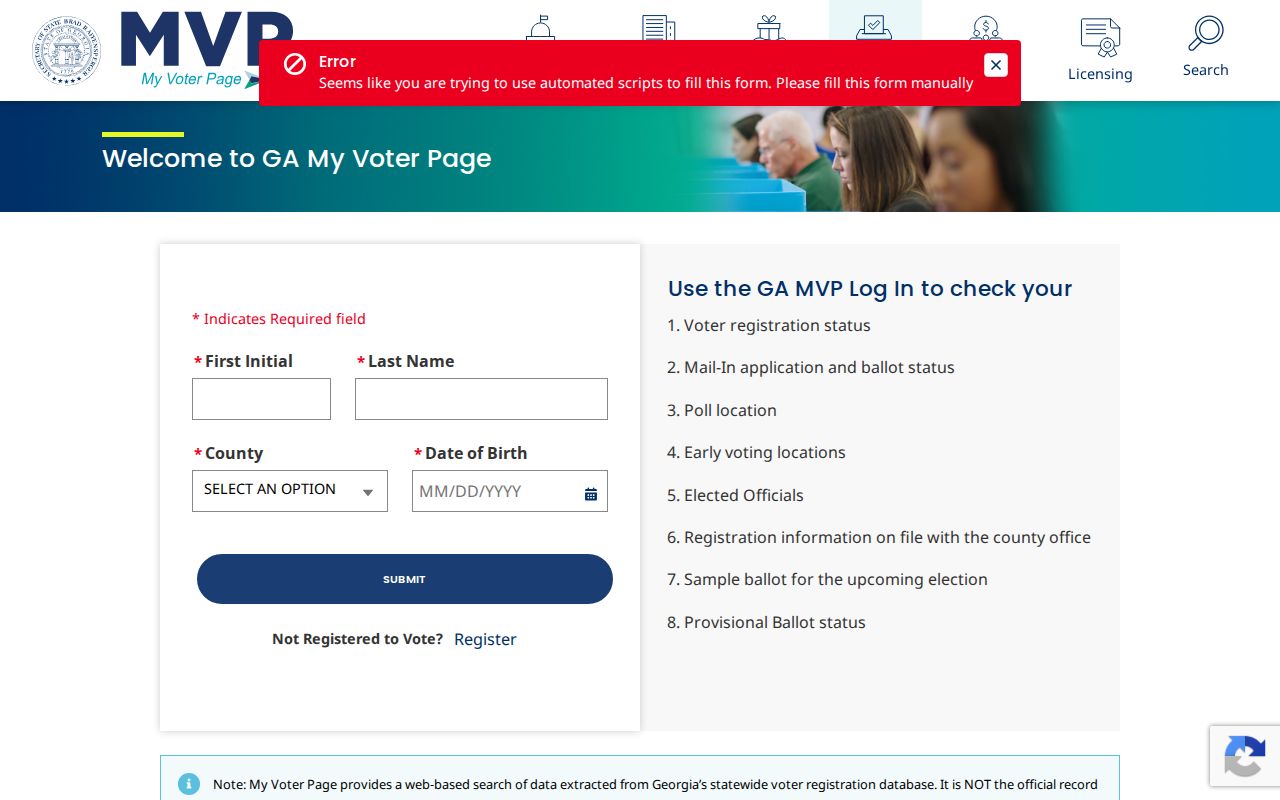
The form's field set explains why it can confirm known details but cannot function as a public block browser.
Current Rolls Used in an Albany Residents Directory
Present-day sources divide people by purpose. Property records cover assessed owners. Voter tools cover registrants under election law. Recorded instruments name transaction parties. Court indexes identify parties in eligible cases, while state business and professional-license databases connect names with public commercial or credential records. None is a general list of every Albany household.
| Source | Who It Lists | Keeper | Access |
|---|---|---|---|
| Dougherty qPublic | Assessed owners | Board of Assessors | Free portal |
| My Voter Page | Known registered voter | Georgia Secretary of State | Identifying inputs required |
| RE Search | Deed, lien, and plat parties | Superior Court clerk | Free data and images |
| CMWebSearch | Parties in eligible cases | Superior and State Courts | Public index; restrictions apply |
| SOS public indexes | Business principals and licensees | Georgia Secretary of State | Free search |
Choose the roll by the claim to verify, then compare the result with a second source. A parcel card supports ownership, not occupancy. A court-name hit requires case details and dates. The full one-person sequence appears in the Albany resident lookup.
Albany Court Indexes Split by Jurisdiction
Dougherty Superior and State Courts use CMWebSearch for eligible civil and criminal case indexes. A typical result can identify a case number, style, parties, filing date, case type, status, judge, events, and disposition, subject to sealing and confidentiality rules. Albany Municipal Court is different: it handles city traffic, ordinance, misdemeanor, and related matters but advertises no anonymous name-search portal. A specific municipal record should be requested through Albany JustFOIA.
The Georgia re:SearchGA platform and appellate resources cover separate statewide material, while federal cases for Dougherty County fall within the U.S. District Court for the Middle District of Georgia and PACER. Similar names are common, so a case match must be checked against dates and another independent attribute.
The Dougherty court search is the local entry point for superior and state case indexes.
The image shows the distinct local portal that should be checked before widening a search to state or federal systems.
Albany Municipal Records Use a Request Fallback
The City Clerk keeps minutes, ordinances, resolutions, campaign filings, and appointed-board records. Albany began a records-management program in 2005 to digitize permanent documents and later built controlled archive storage. That date marks a records initiative, not a promise that all older material is online. When a special portal is absent, Albany's JustFOIA system routes a focused request to the city's designated open-records officer.
Georgia's Open Records Act, O.C.G.A. §§50-18-70 through 50-18-77, calls for production, a lawful response, or a timetable and cost estimate within three business days. It does not promise a large archive in three days. Give the department, record type, name or address, and a bounded date range. The agency need not answer a question or create a new directory.
Albany Probate and Vital Records Have Access Gates
Dougherty County Probate Court, at 225 Pine Avenue, handles estates, guardianships, marriage licenses, and locally issued vital copies. Estate files and published notices can help locate a decedent, executor, heirs, or notice addresses, but adoption and guardianship material can be restricted. The local vital-record counter and Georgia Department of Public Health provide formal copy channels.
Georgia birth certificates are limited to eligible requesters. Death certificates without cause of death are generally available, while cause-of-death information has narrower family or legal eligibility. O.C.G.A. §§31-10-25 and 31-10-26 govern disclosure and copies. Historical work follows separate routes through archives and genealogy collections, not an assumed fixed opening schedule.
Lawful personal use. Use resident records for family, property, civic, or other lawful personal research. Never use a match to stalk, harass, intimidate, or expose a protected person.
Albany Business and License Indexes Add Identity Clues
Georgia's Corporations Division Business Search can connect a name with an entity, registered agent, business address, status, and filing history. The Secretary of State's professional-license verification can confirm a credential and its status. These are affiliation records, not proof of a home address, but they can separate two people who share a name or confirm the business named in an older directory entry.
Search exact and variant names, note the filing or license dates, and compare the public business address with a deed, parcel, or directory source before drawing a conclusion. Document purchases in the corporation system may carry charges even though the index is free.
The official Georgia Business Search provides the public entity index.
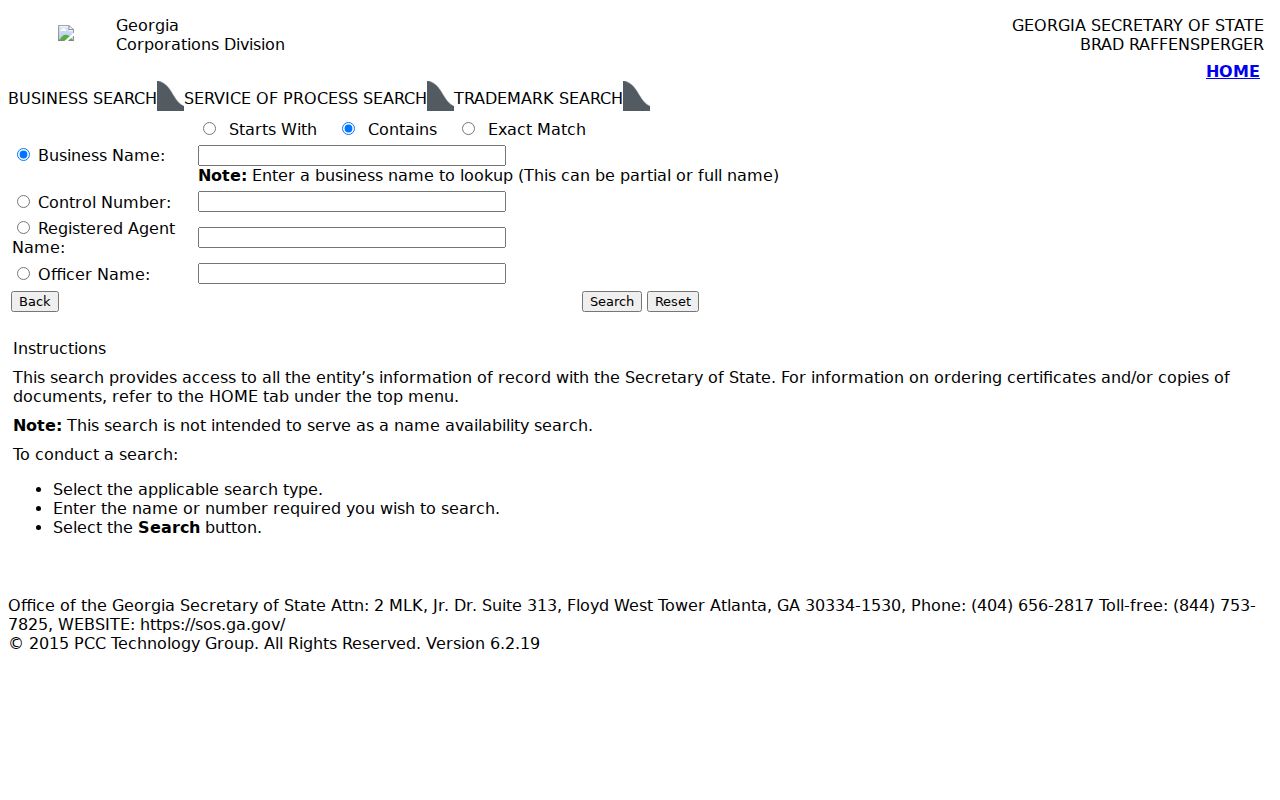
Entity details can supply a second dated attribute, but the listed address must not be assumed to be a residence.
Albany Cemetery Records Continue a Family Trail
Riverside and Oakview are city-managed cemeteries covering about 80 acres. Grounds Maintenance keeps burial and lot records, but the city page does not provide an online interment-name index. The useful fallback is a focused request to the cemetery office with the deceased person's full name, an approximate death or burial date, and the cemetery when known.
Visitors may enter daily from dusk to dawn, while the office lists weekday hours from 7:30 a.m. to 4 p.m. The office can be reached at (229) 302-1420. Burial evidence can bridge an obituary, probate file, family plot, and earlier directory entry without turning any one source into more than it proves.
Official Albany Rolls and Compiled Search Results Differ
An official index exists to administer a public function and points back to a named custodian. A commercial compilation merges public and purchased data from many dates. That can make it quick to scan, but records may be stale, omit context, or combine people with the same name. Paid access does not make a match authoritative.
Official source
Known custodian, defined record purpose, stated access rules, and a route to inspect or request the underlying record.
Commercial compilation
Broad aggregation with uncertain update timing, possible fees, and a need to verify every useful clue at the original office.
Use a commercial compilation only as a clue category. Use qPublic for ownership, RE Search for recorded land, the clerk for cases, and the library or DLG for historical entries.
Albany Residents Directory Volumes Survive Online
Dougherty County Public Library supplied Albany city directories dated 1922 through 1949 to the Digital Library of Georgia. The scans can show names, spouses, occupations, employers, numbered addresses, and later telephone fields. Some editions used discriminatory marks for Black entries; those conventions should be explained as historical evidence, never repeated without context. Machine-generated text is not always correct, so search spelling variants and inspect the scanned page.
Central Library at 300 Pine Avenue also anchors local research in county histories, census material, death registers, deeds, church records, obituaries, cemetery sources, family histories, military material, and local newspaper microfilm reaching back to 1845. The full shelf, entry abbreviations, and household-tracing method belong to the Albany city directory collections.
The official Dougherty County Public Library page identifies the local branches and access points.
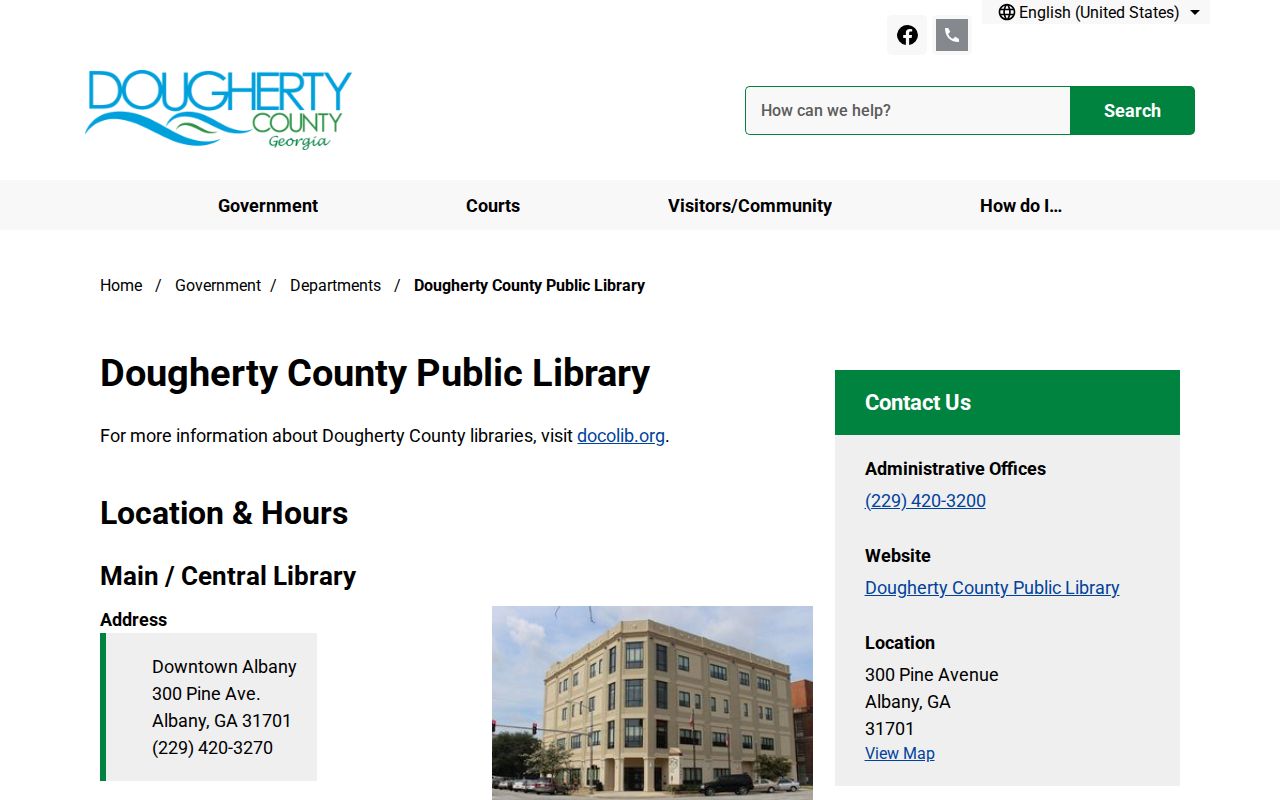
The library is the offline fallback when a year, newspaper, obituary, or directory volume is not available in a searchable web collection.